Functional Core Training: What Your Core Actually Does and How to Train It
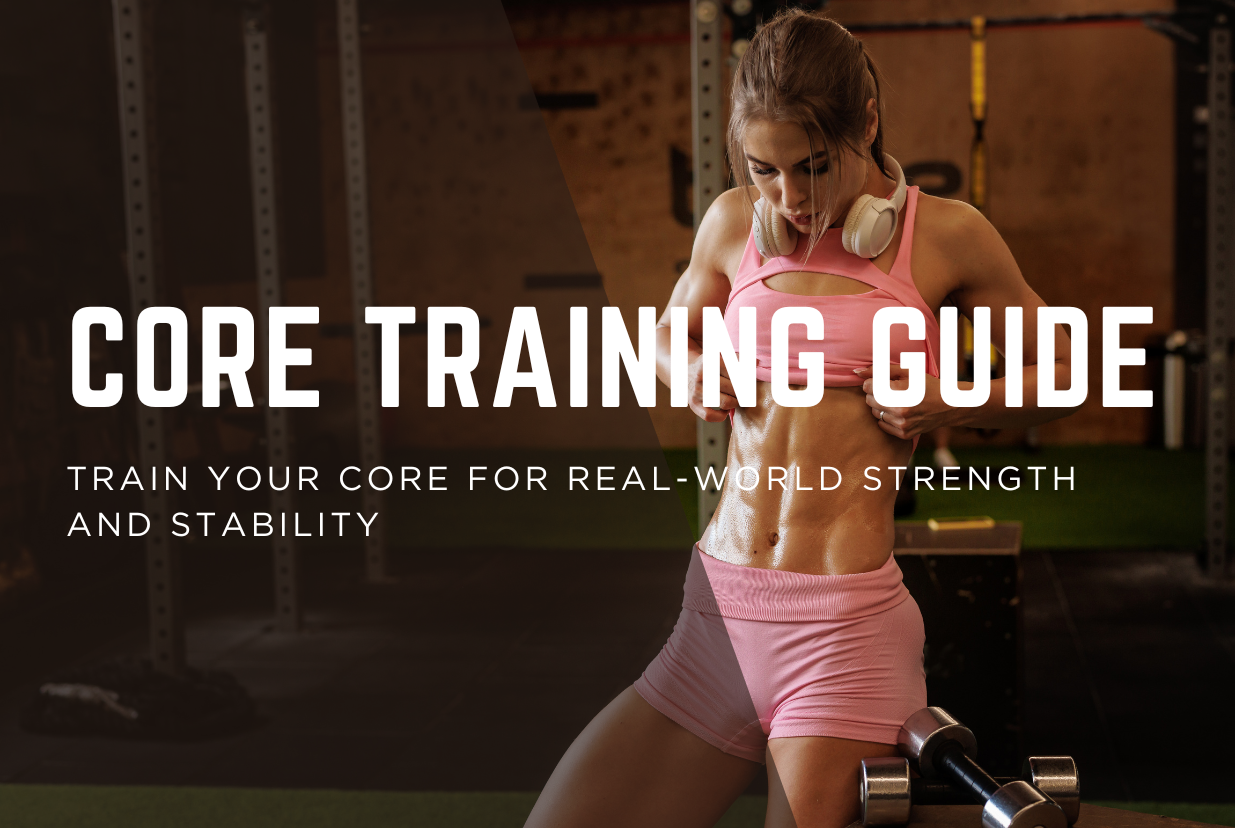
Most core training is built on a false premise: that your core’s primary job is flexion. It isn’t. Your core exists to transfer force, resist unwanted movement, and stabilize your spine under load. Training it primarily through crunches and sit-ups addresses one function while ignoring the three that matter most.
Your Core Is a Pressurized System
Think of your core as a cylinder under pressure, not a single muscle. The walls of this cylinder (rectus abdominis in front, obliques on the sides, erector spinae in back) create structural support. The transverse abdominis wraps horizontally like a natural weight belt, generating internal pressure when it contracts. The diaphragm caps the top. The pelvic floor forms the base.
When this complete system activates together, it creates the stiffness required to transmit force between your upper and lower body and protect your spine under load. Research by McGill (2010, Journal of Bodywork and Movement Therapies) established that spinal stability depends on the coordinated activation of all these muscles, not the strength of any individual component.
This is why someone can have visible rectus abdominis development and still experience back pain or poor core function. Isolated strength in one component doesn’t create integrated stability.
The Four Functional Patterns
Core training should address four movement categories. Neglecting any one creates a gap that shows up as weakness, compensation, or injury risk when real-world demands find it.
Anti-Extension
Your core’s ability to resist excessive lumbar arching. This is the pattern most people are weakest in because they’ve never trained it deliberately.
Every time you hold a heavy load overhead, press from a standing position, or perform a push-up, your lumbar spine wants to extend. Your core must resist this. Failure to do so creates the exaggerated arch you see in people who bench press or overhead press with poor positioning, and eventually the back pain that follows.
Key exercises. Hollow holds, dead bugs, ab wheel rollouts, plank variations with forward reach. Progression comes from increasing lever length, adding load, or reducing contact points.
Programming. Hollow holds for 3 sets of 20-30 seconds. Dead bugs for 3 sets of 8-10 per side with controlled tempo. Ab wheel rollouts for 3 sets of 6-10 reps.
Anti-Lateral Flexion
Resisting forces that try to bend your spine sideways. This pattern is essential for any asymmetric loading: carrying a bag in one hand, single-arm pressing, single-arm rowing.
Unilateral exercises automatically train anti-lateral flexion as a secondary demand. But dedicated training builds the capacity faster and more completely.
Key exercises. Side planks, suitcase carries, single-arm farmer carries, offset loading variations. Progression through increased hold time, heavier loads, or movement complexity (walking vs static hold).
Programming. Side planks for 3 sets of 20-30 seconds per side. Suitcase carries for 3 sets of 30-40 meter walks per side.
Anti-Rotation
Resisting forces that try to twist your spine. Arguably the most important pattern for spinal health, and the one most commonly absent from training programs.
Every rowing variation, single-arm press, and asymmetric movement demands anti-rotational stability. Without it, force bleeds through rotational compensation rather than transferring efficiently.
Key exercises. Pallof press (cable or band), single-arm plank holds, bird dogs, half-kneeling chops. The Pallof press is particularly effective because it isolates the anti-rotational demand. You hold a band or cable at chest height and resist its pull without rotating.
Programming. Pallof press for 3 sets of 10-12 per side with 2-second holds at full extension. Bird dogs for 3 sets of 8-10 per side with deliberate control.
Flexion and Rotation
The pattern most people overtrain relative to the others. Crunches, sit-ups, Russian twists. These have their place (the rectus abdominis does perform spinal flexion and should be trained) but they should represent roughly 25% of core training volume, not 100%.
Key exercises. Controlled sit-ups with tempo, cable crunches, hanging knee raises, cable woodchops. Progress through range of motion, load, or lever length.
Programming. Hanging knee raises for 3 sets of 8-12. Cable woodchops for 3 sets of 10-12 per side.
Breathing Is Core Training
Your diaphragm is both a breathing muscle and a core stabilizer. Learning to maintain core tension while breathing normally, rather than holding your breath, is a trainable skill that improves performance on every other exercise.
Research by Kolar and colleagues (2012, Journal of Applied Biomechanics) demonstrated that diaphragmatic function directly affects spinal stabilization. Subjects with poor diaphragm activation showed reduced core stiffness under load.
Practice diaphragmatic breathing during low-intensity core work. Place one hand on your chest and one on your belly. Breathe so the belly hand moves more than the chest hand. Maintain mild abdominal bracing throughout. This pattern should become automatic during all training.
Progressive Overload for Core
Your core adapts to progressive overload like any other muscle group. The mistake is treating core training as high-rep burnout work instead of progressive strength training.
Time progression for isometric holds. Add 5 seconds per session until you reach 45-60 seconds, then add load or reduce stability rather than continuing to extend time.
Load progression for dynamic exercises. Add weight to cable crunches, use heavier loads for Pallof presses, hold dumbbells during sit-ups.
Lever progression for bodyweight exercises. Extend limbs, reduce contact points, or add perturbation. An ab wheel rollout is a plank with a dramatically longer lever arm.
Stop training core for the burn. Train it for progressive strength, just like everything else.
Integration Over Isolation
Dedicated core training is valuable, but the majority of core development in a well-designed program happens during compound lifts. Heavy squats, deadlifts, overhead presses, loaded carries, and single-arm exercises all demand significant core activation.
A study by Martuscello and colleagues in the Journal of Strength and Conditioning Research compared core activation during isolation exercises versus compound movements and found that exercises like squats and deadlifts produced comparable or greater core muscle activation than many traditional core exercises.
This doesn’t mean you skip dedicated core work. It means you can get most of the stimulus from 10-15 minutes of targeted core training per session, addressing the anti-extension, anti-lateral flexion, and anti-rotation patterns that compound lifts may underserve, rather than devoting entire sessions to core isolation.
The FLEX Program integrates core work into every session, with exercise selection cycling through all four functional patterns across the training week. The compound lifts provide foundational core demand, and targeted accessory work fills the gaps.