The Case for Being Good at Everything
You follow a program religiously. Hit every rep, every set, every workout. Your numbers are climbing. Your dedication is unquestionable.
But somehow, the results you see on Instagram aren’t showing up in your mirror. You’re stronger than last year, but you don’t look it. Or you look better, but real-world tasks still leave you winded.
The frustration is real. And it usually comes down to one fundamental misunderstanding: you picked a specialized program but expected generalized results.
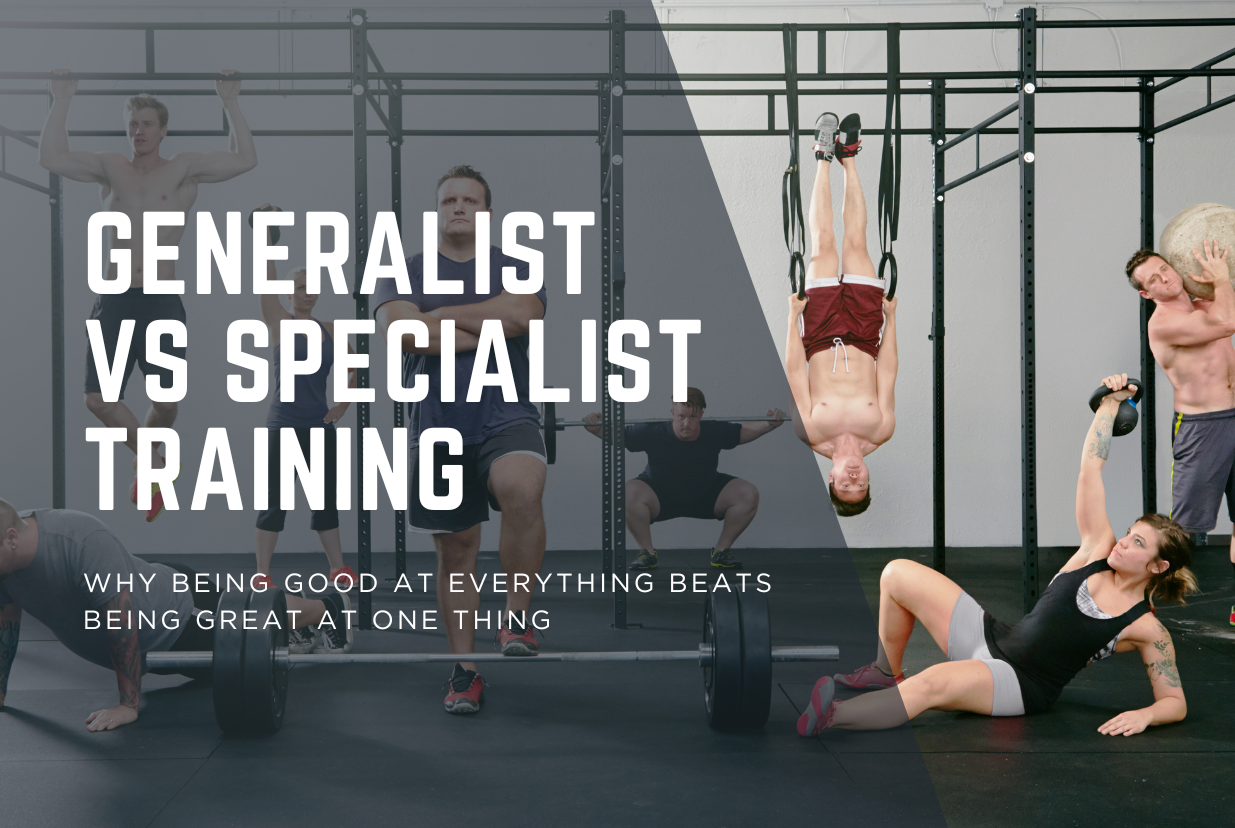
Most people choose training programs based on what looks impressive online, not what actually serves their life. They follow bodybuilding splits when they play weekend sports. They run powerlifting programs when they want to look good at the beach. They commit to marathon training when they actually need to be strong, mobile, and capable across multiple domains.
Here’s the truth that most fitness content won’t tell you: you cannot maximize everything simultaneously. Your body has limited recovery resources, limited time, and limited adaptation capacity. Every training choice involves tradeoffs.
The question isn’t whether specialization or generalization is better. The question is which one actually matches your goals and your life.
The Biology of Tradeoffs
Think of your training capacity like a fixed budget. You have 100 units to spend each week. You can allocate 70 units to strength, 20 to conditioning, and 10 to mobility. Or you could split it 40/40/20. Or any other combination.
But you can’t spend 120 units just because you want more results. The pie is fixed. You can slice it however you want, but you can’t make it bigger through sheer willpower.
This isn’t a limitation of your program. It’s biology.
When you dedicate most of your training to one quality, you’ll excel at it. A powerlifting program will make you incredibly strong at three specific lifts. A bodybuilding program will maximize muscle growth. A marathon plan will turn you into an endurance machine.
But that excellence comes at a cost. The powerlifter who can squat 500 pounds might get winded walking up stairs. The bodybuilder with perfect aesthetics might lack the conditioning to play pickup basketball. The marathon runner might struggle to move furniture because they have zero functional strength.
Specialization creates excellence in one area and weakness everywhere else.
The Specialist: Dominant in One Lane
A specialized program is like a Formula 1 race car. Engineered for one specific purpose. Absolutely dominant in that arena. Completely useless everywhere else.
What the specialist gets: maximum adaptation in their chosen area, clear and measurable progress toward a specific goal, the satisfaction of truly excelling at something, faster results in their target domain, and impressive numbers or aesthetics in one quality.
What the specialist sacrifices: capability in other physical domains, real-world functionality outside their specialty, higher injury risk from repetitive stress patterns, often boring and monotonous training, and regression or stagnation in untrained qualities.
If you’re competing in powerlifting, bodybuilding, or endurance events, specialization makes sense. You need to be exceptional in one narrow domain, and you’re willing to accept weakness everywhere else.
But most people aren’t competing in anything. They just want to be capable, look decent, and feel good.
The Generalist: Capable Across the Board
A generalized program is like a well-built pickup truck. It won’t win races. It won’t turn heads at a car show. But it’ll handle whatever you throw at it. Moving furniture, road trips, light off-roading, daily commutes. It’s ready for everything.
What the generalist gets: well-rounded fitness and athleticism, lower injury risk from movement variety, better real-world functionality, more engaging and varied training, resilience across multiple physical demands, and confidence in their body’s capabilities.
What the generalist sacrifices: slower progress in any single area, less impressive numbers on paper, may never feel “great” at any one thing, requires patience with the process, and won’t win specialized competitions.
For the average person who wants to be healthy, capable, and ready for whatever life throws at them, this is the right choice. You won’t set world records, but you’ll be stronger, fitter, and more capable than 95% of the population.
When Your Goals and Your Program Don’t Match
This is where most people go wrong. They choose a program based on what looks cool or what their favorite influencer does, not what actually serves their goals.
Someone follows CrossFit or a balanced strength program, then gets frustrated they don’t look like a bodybuilder who does nothing but hypertrophy work and strategic dieting. Someone runs a powerlifting program focused on low-rep max strength, then wonders why their conditioning is trash and they gas out playing with their kids. Someone trains for marathons, then can’t understand why they struggle with basic strength tasks like carrying groceries or moving furniture.
It’s like buying a pickup truck and being upset it doesn’t corner like a sports car. The truck isn’t broken. Your expectations are just misaligned with what you’re actually driving.
What Real Life Actually Demands
Here’s what most people don’t realize: real life doesn’t care about your bench press max or your bicep peak or your 5K time.
Real life cares whether you can play with your kids without getting exhausted, move furniture when you need to, hike that trail on vacation without suffering, react quickly if you trip or stumble, carry groceries, luggage, and life’s demands without injury, and feel confident in your body regardless of the situation.
Think about the weekend warrior who plays recreational basketball on Thursdays, goes hiking on weekends, helps friends move apartments, and wants to look decent at the beach. A powerlifting program might make them strong, but they’ll be slow and tired. Marathon training might give them endurance, but they’ll be weak and fragile. They need capabilities across multiple domains.
Or the busy parent managing a career, family, and household. They don’t have time for two-hour gym sessions. They need training that delivers maximum benefit per hour spent. Not just aesthetics or raw strength, but genuine, everyday capability in a time-efficient package.
These scenarios describe most people. And the research on long-term health backs this up.
The Case for Broad-Based Fitness
The health data is clear: combining resistance training with cardiovascular conditioning produces the best long-term outcomes. A 2022 meta-analysis published in the British Journal of Sports Medicine (Momma et al.) found that muscle-strengthening activities were associated with a 10-17% lower risk of all-cause mortality, cardiovascular disease, total cancer, and diabetes. But the more striking finding was the combination effect: people who combined resistance training with aerobic exercise showed a 40% lower risk of all-cause mortality and a 60% lower risk of cardiovascular mortality compared to those who did neither.
A 2024 study in the International Journal of Epidemiology (Boyle et al., using the NIH-AARP cohort of over 216,000 older adults) confirmed this pattern. Performing both weight training and aerobic exercise produced the greatest mortality risk reduction. Resistance training alone, without any aerobic exercise, showed no significant mortality benefit. The combination is what matters.
The American Heart Association’s 2023 scientific statement on resistance exercise put specific numbers to it: compared with adults doing no activity, those who combined resistance and aerobic training had a 40-46% lower risk of all-cause and cardiovascular mortality, while resistance or aerobic training alone was associated with an 18-29% lower risk.
What does this mean practically? A training approach that develops both strength and conditioning together, rather than focusing exclusively on one, is not just more functional. It’s more protective against the diseases that actually kill people.
Understanding the Physical Qualities
To build broad-based fitness intelligently, you need to understand what you’re training. Physical fitness breaks down into distinct qualities, and each quality requires specific training stimulus.
Strength is the ability to produce force. Trained through progressive resistance using compound and isolation movements with deliberate loading strategies. Measured by how much weight you can move through a given range of motion.
Power is the ability to produce force quickly. Trained through explosive movements like jumps, throws, and Olympic lift variations. It’s what lets you sprint, jump, and react fast. Power declines faster than strength with age, which is why it matters for longevity.
Hypertrophy is muscle growth. Trained through sufficient mechanical tension and training volume near failure. Beyond aesthetics, muscle mass is a significant predictor of long-term health, metabolic function, and resilience to illness and injury.
Aerobic capacity is your body’s ability to use oxygen to produce energy over extended periods. Trained through sustained effort at lower to moderate intensities. It determines how quickly you recover between efforts and how efficiently your cardiovascular system operates at rest and under load.
Anaerobic capacity is your ability to produce energy without sufficient oxygen, fueling short, intense efforts. Trained through higher-intensity work with incomplete recovery. It determines how hard you can push in short bursts.
Muscular endurance is the ability of a muscle or muscle group to perform repeated contractions under load without failing. Trained through higher rep ranges and sustained work.
Work capacity is your ability to handle training volume and recover from it. It develops as a byproduct of consistent, well-managed training across all other qualities.
Conditioning: More Than Just Cardio
Here’s where most people’s understanding breaks down. Conditioning is not just “cardio” or getting your heart rate up. Conditioning is the development of your physical qualities and the skills to use them effectively across varied physical demands.
That second part is what separates someone who is fit from someone who is conditioned. You can have a massive aerobic engine and still fall apart in a workout because you don’t know how to pace yourself. You can have incredible anaerobic power and still gas out in round three because you went too hard in round one.
Conditioning builds physical qualities (aerobic capacity, anaerobic capacity, muscular endurance, work capacity) through structured training at varied intensities. But it also develops skills: pacing, breathing, technique under fatigue, and effort calibration. These skills determine whether you can actually use your fitness when it counts.
Pacing is the ability to select and maintain the right intensity for a given task. It sounds simple, but watch any gym and you’ll see people destroy themselves in the first five minutes of a twenty-minute workout, then crawl through the remaining fifteen. Pacing is a trainable skill that improves through deliberate practice with varied intensity targets.
Breathing is using your respiratory system efficiently under stress. Untrained people default to shallow, rapid chest breathing when they’re tired. Trained conditioning athletes maintain controlled breathing patterns that regulate heart rate, maintain core stability, and delay the onset of fatigue.
Technique under fatigue is movement quality preservation when you’re gassed. This is where most breakdowns happen and where injuries occur. The ability to maintain proper mechanics in the final rounds of a hard workout is a conditioning skill, not just a strength issue.
Effort calibration is knowing what different intensity levels actually feel like in your body. Can you tell the difference between 70% effort and 90% effort? Most people can’t. They have two gears: easy and all-out. Developing the ability to modulate output is what separates someone who trains conditioning from someone who just does hard workouts. This is why FLEX uses pacing targets (Forever, Sustainable, Aggressive, All-Out) tied to RPE ranges instead of just telling you to “go hard.”
The distinction between fitness and conditioning matters because you can be physically fit (high capacity numbers) while being poorly conditioned (unable to use that capacity effectively). Real capability requires both.
GPP vs SPP: When You Need Each
Now that we understand physical qualities and conditioning skills, we can talk about how to organize training for long-term capability rather than short-term performance spikes.
GPP: General Physical Preparedness
GPP is broad-based development across all physical qualities without sport-specific focus.
It includes strength across fundamental movement patterns, hypertrophy for muscle and structural resilience, aerobic and anaerobic capacity development, conditioning skills (pacing, breathing, technique under fatigue), resilience training for joint and tendon capacity, and movement quality and mobility work.
GPP is for people focused on longevity and health, athletes in the off-season building their base, anyone who wants general capability without specializing, and recreational exercisers without competitive goals.
Why it works: GPP develops physical qualities AND conditioning skills across broad domains. For most people, this is a complete program.
A well-structured GPP program builds strength and hypertrophy through dedicated resistance training, aerobic and anaerobic capacity through conditioning with varied intensity, conditioning skills through intentional pacing and format variation, and resilience and durability through movement variety and progressive loading.
The key is that all these qualities develop together, not in isolation. You don’t spend three months just building muscle, then three months just doing conditioning. A well-designed program integrates all these qualities within each week. You build strength through dedicated barbell and dumbbell work. You develop muscle through focused hypertrophy training. You sharpen conditioning through intelligent work at varied intensities across all three conditioning layers: aerobic base development, mixed-modal conditioning, and high-intensity intervals. And they all support each other rather than compete.
The result is someone who’s capable in their 30s, stays strong and mobile in their 50s, and remains independent and resilient into their 70s and beyond. That’s the payoff of complete, integrated training.
SPP: Specific Physical Preparedness
SPP is targeted training that mirrors your exact sport or event demands.
It includes work-to-rest ratios that match competition, movement patterns specific to the sport, energy system emphasis aligned with event demands, position-specific drills and transitions, and mental preparation for competitive scenarios.
SPP is for competitive athletes, anyone training for a specific event (marathon, HYROX, Spartan Race, powerlifting meet), and people pursuing elite-level performance in a discipline.
The critical rule: SPP only works if you have a solid GPP foundation first. You can’t sharpen a blade that doesn’t exist.
How to Transition: GPP to SPP
Phase 1: GPP Base (8 to 16 weeks). Build broad capacity across all physical qualities and conditioning skills.
Phase 2: Integration (4 to 6 weeks). Keep GPP volume but add sport-specific elements. Roughly 70% GPP, 30% SPP.
Phase 3: SPP Focus (8 to 12 weeks). Shift emphasis to competition-specific work. Roughly 30% GPP maintenance, 70% event-specific conditioning.
Phase 4: Taper and Compete. Reduce volume, maintain intensity, prioritize readiness.
Phase 5: Return to GPP. After competition, rebuild general capacity for 4 to 8 weeks. Reset the foundation before the next specialization cycle.
The cycle repeats: GPP builds the foundation, SPP sharpens performance, return to GPP, repeat.
Two Ways to Train for General Fitness
If GPP is the goal (and for most people reading this, it should be), there are two well-established approaches to structuring your training. Both are supported by research and both produce the combined adaptations that the health and longevity data point to.
Same-Session Concurrent Training
This approach combines strength, hypertrophy, and conditioning within every session. You lift, then you condition. Every day includes both. The academic literature calls this “intra-session concurrent training” or same-session concurrent training.
The advantage: nothing gets skipped, even on a short training week. If you can only train three days instead of five, you still get both strength and conditioning stimulus in every session. There’s no “I’ll do cardio tomorrow” that never happens. It’s also time-efficient. One session, everything covered.
The research on concurrent training consistently shows that moderate conditioning volume after lifting does not significantly impair strength or hypertrophy development when total volume and intensity are managed intelligently. A 2012 meta-analysis examining 21 studies found that while excessive endurance work can blunt strength gains, the effect is dose-dependent and largely avoidable with smart programming.
This is how FLEX Program is structured. Five days per week, every session includes performance work (strength and hypertrophy) followed by conditioning. The conditioning duration and intensity vary by day type. Heavier strength days get shorter, more intense conditioning pieces. Days with lighter performance work allow for longer conditioning at lower intensities. Pacing targets are built into every conditioning piece so members develop the skill of effort calibration alongside the physical qualities.
Separate-Session Concurrent Training (Hybrid)
This approach dedicates separate sessions to strength and conditioning. You might lift three days per week and run or do endurance work two to three days per week. The academic literature calls this “separate-session concurrent training.” The fitness industry commonly refers to it as hybrid training.
The advantage: each quality gets a full, focused session. Your lifting days have no time pressure from conditioning work. Your conditioning days can include longer aerobic pieces (40-60 minutes) that are harder to fit into a same-session structure. This approach naturally covers all three conditioning layers, including aerobic base development, which is the hardest layer to fit into a same-session model.
Hybrid works well for people who enjoy running or cycling as standalone activities, people who want to train for a specific endurance event while maintaining strength, and people who prefer focused sessions dedicated to one quality.
Neither Is Superior
Both approaches develop the combination of strength and conditioning that the mortality research identifies as optimal. The difference is organizational, not physiological. Same-session concurrent training guarantees nothing gets skipped and works well for people with variable schedules. Hybrid gives each quality more room to breathe and naturally accommodates longer aerobic development.
For pure aerobic development specifically, a hybrid approach with dedicated endurance sessions does have a slight edge. Steady-state work at controlled intensities is a more targeted aerobic stimulus than mixed-modal conditioning at conversational pace. But for overall fitness and health outcomes in the general population, the research shows no clear winner. Choose the structure that fits your life, your preferences, and your goals.
What Actually Matters Beyond the Numbers
Most people chase fitness metrics as if better numbers guarantee better performance. They don’t.
Fitness metrics like VO2 max, rep maxes, resting heart rate, and body composition matter. They show you’re building capacity. But they don’t tell the whole story.
Conditioning quality markers are what actually predict performance. Pacing accuracy: how close you stay to target pace across a workout. Heart rate recovery: how many beats per minute you drop in the first minute after effort. Technique consistency: movement quality in late sets versus early sets. RPE versus output drift: does perceived effort skyrocket while actual output stays steady (inefficiency) or does output stay high while RPE stays manageable (efficiency). Split consistency: are your round times steady or do they fall off a cliff?
The difference between a fitness-focused approach and a conditioning-focused approach is the difference between “my VO2 max went from 50 to 55 and my squat went up 40 pounds” and “my splits in the last round are now within 5% of my first round, my heart rate recovers 20 beats per minute faster between efforts, and my technique holds even when I’m gassed.”
Both matter. But only one predicts performance under pressure.
For Most People: GPP Is the Answer
When you need more, you layer SPP on the foundation. You don’t abandon GPP. You use it as the base and add sport-specific work on top.
Keep foundational strength and aerobic work. Add event-specific conditioning that mirrors competition demands. Practice the exact scenarios you’ll face. After the event, return to GPP to rebuild.
This is exactly how FLEX is designed to work. The concurrent structure builds and maintains a broad fitness base. If you decide to train for a specific event, you can layer sport-specific work on top of it or step away from FLEX temporarily to specialize, knowing you have a solid foundation to return to.
The Complete Picture
Physical qualities are your capacities: strength, power, hypertrophy (developed through dedicated strength and hypertrophy training), aerobic capacity, anaerobic capacity, muscular endurance, and work capacity (developed through conditioning training).
Conditioning is the integration. Building physical qualities through structured training at varied intensities. Developing the skills to use them efficiently: pacing, breathing, technique under fatigue, and mental performance.
Strength and hypertrophy training emphasizes force and structure. Conditioning training emphasizes physical qualities and skills. Both develop fitness. Together, they create capability.
For most of you reading this, a complete GPP program is everything you need. It develops the physical qualities and conditioning skills that serve longevity, capability, and resilience. Whether you structure it as same-session concurrent training (everything in one session) or hybrid (strength and conditioning on separate days), the outcome is the same: a body that’s ready for whatever life throws at it.
And if you decide to pursue something specific, a race, a competition, an event, you’ll have the foundation to specialize effectively. You need sport-specific programming for that. There is absolutely no way around it. But the base that GPP builds? That’s what makes the specialization work.
Build the base. Develop the skills. Then choose your path.