Training for Longevity: The Physical Qualities That Keep You Independent
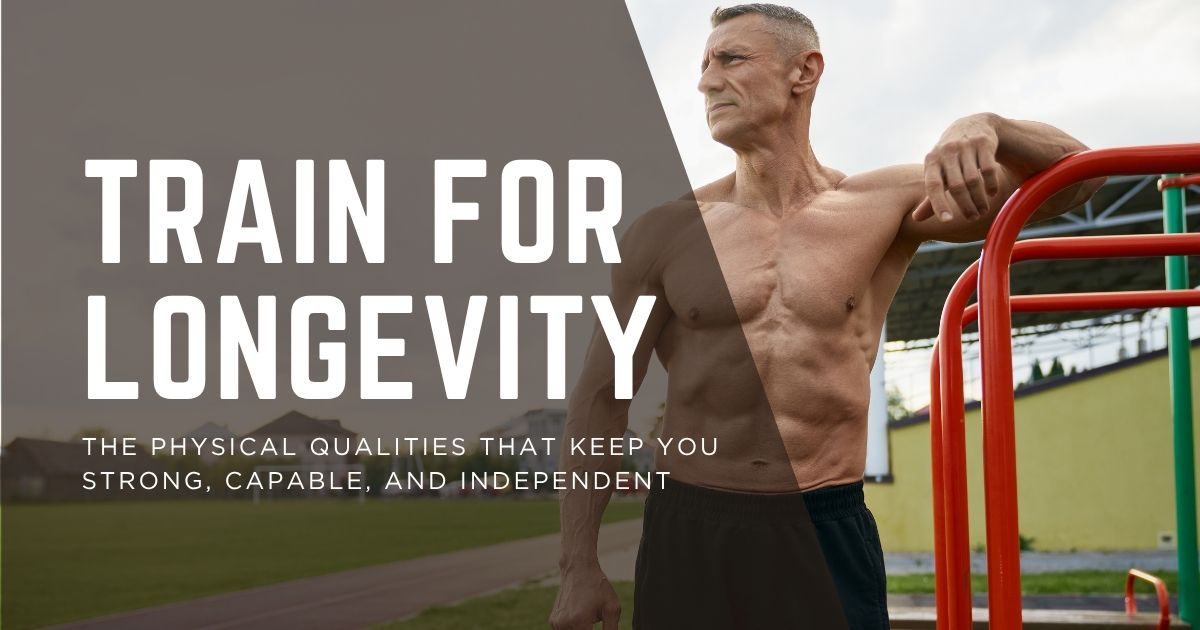
The conversation around exercise and aging has shifted dramatically in the past decade. The old model treated exercise after 40 as damage control: light cardio, gentle stretching, maybe some machine work with modest weight. The research tells a completely different story.
The physical qualities that predict whether you’ll be independent, mobile, and resilient at 70 are the same ones that make you capable at 40. Strength, muscle mass, cardiovascular fitness, balance, and the ability to get up and down from the floor without assistance. These aren’t abstract fitness goals. They’re the difference between living on your own terms and needing help with basic tasks.
What Actually Declines With Age
Muscle mass begins decreasing around age 30, accelerating after 50. This process, called sarcopenia, reduces strength, metabolic rate, and functional capacity. Research by Cruz-Jentoft and colleagues (2019, Age and Ageing) found that sarcopenia affects approximately 10-16% of the global elderly population and is associated with increased falls, fractures, hospitalization, and mortality.
The rate of decline is not fixed. It depends almost entirely on activity level. Trained individuals in their 60s consistently outperform untrained individuals in their 30s on measures of strength, power, and cardiovascular fitness. The decline is real, but training dramatically slows it.
Cardiovascular capacity (VO2 max) drops roughly 10% per decade after age 30 in sedentary individuals. Research by Mandsager and colleagues (2018, JAMA Network Open) found that cardiorespiratory fitness was inversely associated with long-term mortality, with the highest-fit group showing 80% lower mortality risk compared to the lowest-fit group. Critically, moving from “low fitness” to “moderate fitness” produced the largest absolute risk reduction.
Balance and proprioception (your sense of where your body is in space) also decline with age, increasing fall risk. Falls are the leading cause of injury-related death in adults over 65. Balance is trainable at any age, and strength training itself improves balance by developing the muscular control needed to recover from perturbations.
Bone density peaks around age 30 and declines thereafter, particularly in women post-menopause. Resistance training is one of the most effective interventions for maintaining bone mineral density. Research by Howe and colleagues (2011, Cochrane Database of Systematic Reviews) found that progressive resistance training significantly reduced bone loss at clinically important sites including the hip and spine.
The Five Pillars of Longevity Training
1. Strength
Not “toning.” Not “light resistance for high reps.” Actual strength training with loads heavy enough to challenge you in the 5-10 rep range. This is non-negotiable for maintaining muscle mass, bone density, and functional independence.
The fear that heavy lifting is dangerous for older adults is not supported by evidence. A 2011 meta-analysis by Peterson and colleagues found that higher-intensity resistance training produced greater strength gains in older adults than lower-intensity protocols, with no increase in adverse events.
Heavy is relative. A 65-year-old training with 70-80% of their one-rep max is training “heavy” in the physiological sense that matters, even if the absolute load is modest. The stimulus is what counts.
Minimum effective dose: 2-3 sessions per week including compound movements (squat pattern, hinge pattern, press, pull) trained for 2-4 sets of 5-10 reps with progressive overload.
2. Muscle Mass
Strength and hypertrophy overlap significantly, but they’re not identical. You can get stronger through neural adaptations without adding muscle, and you can add muscle without maximizing strength. Both matter for longevity.
Muscle mass serves as a metabolic reserve. During illness, injury, or surgery, the body catabolizes muscle for energy and immune function. Starting with more muscle means more reserve during periods of stress. Research by Srikanthan and Karlamangla (2014, American Journal of Medicine) found that higher muscle mass index was associated with lower all-cause mortality independent of fat mass and cardiovascular risk factors.
Building and maintaining muscle after 40 follows the same principles as at any age: sufficient training volume (10-20 hard sets per muscle group per week), proximity to failure, adequate protein, and progressive overload. The only difference is that recovery may take slightly longer, which means slightly lower weekly volume or additional rest days may be appropriate.
Protein becomes more important with age. Research on anabolic resistance (the age-related dulling of the muscle-building response to protein and training) suggests that older adults need higher per-meal protein doses to stimulate equivalent muscle protein synthesis. Current evidence supports 1.6-2.2 grams per kilogram bodyweight daily, distributed across 3-4 meals with at least 30-40 grams per meal.
3. Cardiovascular Fitness
VO2 max is one of the strongest predictors of all-cause mortality at any age. The relationship is dose-dependent: more fitness equals lower risk, with no upper threshold identified where additional fitness stops being beneficial.
The practical application is straightforward. Include structured cardiovascular training 2-4 times per week. This can range from steady-state work (walking, cycling, rowing at moderate intensity for 20-40 minutes) to interval training (repeated bouts of higher-intensity effort with recovery periods).
Both modalities improve cardiovascular fitness. Interval training is more time-efficient and produces comparable or superior improvements in VO2 max per unit of time. Steady-state work builds aerobic base and is generally better tolerated as session volume increases.
For most people, a combination works best: 1-2 interval sessions per week alongside daily low-intensity movement (walking, cycling for transportation, recreational activity).
4. Balance and Proprioception
Balance training is often treated as something you add after a fall scare. It should be built into training from the start.
Single-leg exercises (split squats, step-ups, single-leg Romanian deadlifts) train balance as an inherent component of strength work. Loaded carries challenge postural stability under movement. Turkish get-ups train the ability to transition between floor and standing positions under load.
Dedicated balance work becomes more important after 50: single-leg stands (eyes open, then eyes closed), tandem walking, and reactive balance drills where you recover from perturbation. Even 5-10 minutes per session makes a meaningful difference.
5. Movement Quality and Range of Motion
Maintaining the ability to squat to full depth, reach overhead without compensation, and get up and down from the floor without assistance is more important than any performance metric.
Training through full ranges of motion is itself a mobility intervention. Deep squats maintain hip and ankle mobility. Overhead pressing maintains shoulder flexion. Deadlifts from the floor maintain hip hinge capacity. The best mobility program is a strength program performed through complete ranges.
Dedicated mobility work fills the gaps: hip flexor stretching if you sit for extended periods, thoracic spine rotation if you’re desk-bound, and ankle mobility if squat depth is limited.
Programming for Longevity
The ideal longevity program looks remarkably similar to a well-designed general fitness program. That’s not a coincidence. The physical qualities that make you capable at 40 are the ones that keep you independent at 70.
A weekly structure might look like: 3-4 training sessions per week, each including a compound strength movement trained progressively, 2-3 accessory exercises for muscle mass and movement quality, and 10-20 minutes of conditioning. Add daily walking or low-intensity movement on non-training days. Total weekly time commitment: 4-6 hours including warm-ups.
The critical insight is that longevity training is not a separate category of training. It’s regular training done consistently over decades. The 35-year-old who starts training intelligently now and never stops has a better physical prognosis at 70 than someone who starts a “longevity program” at 65.
Start now. Train the basics. Don’t stop.
The FLEX Program covers all five longevity pillars in every training block: compound strength, accessory hypertrophy, structured conditioning, single-leg balance work, and full range of motion training. It scales from beginner to advanced because the principles don’t change with ability level, only the loads and movement complexity.


