Handstand Push-Up Scaling: Building Overhead Pressing Strength From the Ground Up
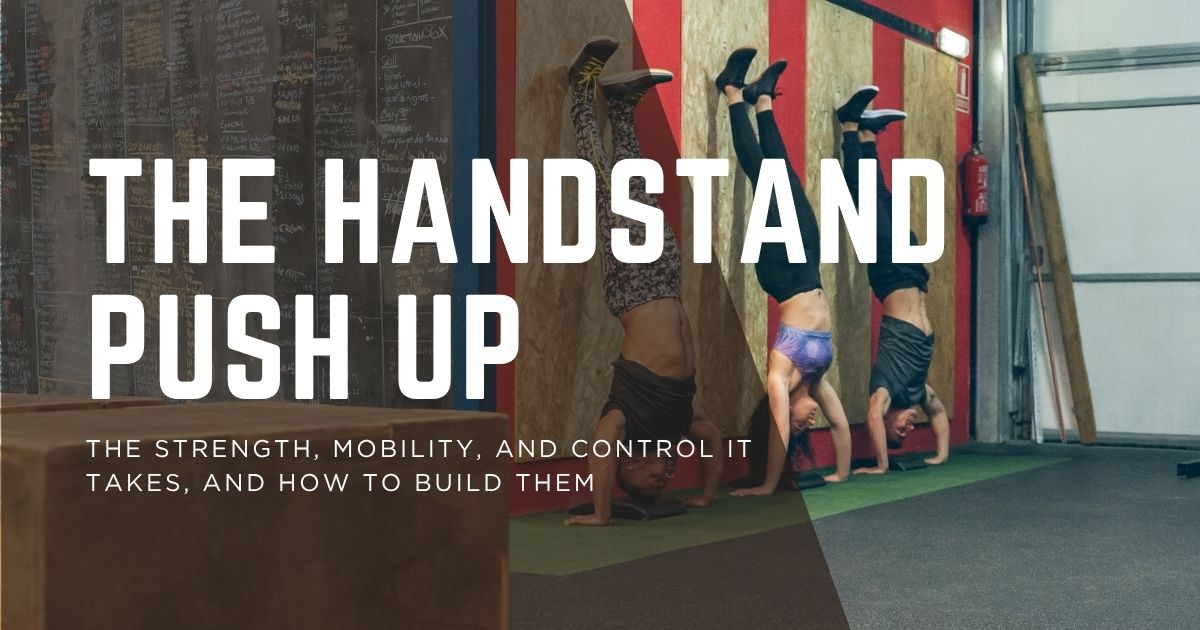
Kick up to a wall, lower your head to the floor, press back up. The handstand push-up sounds simple and humbles almost everyone who tries it cold. It demands pressing strength, overhead mobility, balance, and core control at the same time, which is exactly why it is worth building toward and exactly why you should not start on the wall.
These progessions build the specific strength required for handstand push-ups while developing overhead pressing capacity that transfers to every other pressing movement.
What Handstand Push-Ups Demand
The handstand push-up places roughly 90-100% of your bodyweight on your shoulders and triceps through a vertical pressing pattern. By comparison, a standard push-up loads approximately 64% of bodyweight (Suprak and colleagues, 2011, Journal of Strength and Conditioning Research).
Beyond raw pressing strength, the movement requires adequate shoulder flexion range of motion (the ability to reach directly overhead without compensation), scapular stability in an inverted position, and midline control to maintain body position against gravity.
Attempting handstand push-ups without these prerequisites typically results in compensatory movement: excessive back arching, limited range of motion, or collapse out of position.
Progression 1: Pike Push-Up
Place your hands on the floor and walk your feet forward until your hips are directly over your shoulders, forming an inverted V shape. Lower your head toward the floor by bending your elbows, then press back up.
This is the entry point for vertical pressing with bodyweight. The pike position places more load on the shoulders than a standard push-up but significantly less than a full handstand push-up. The degree of difficulty depends on how vertical your torso becomes. Feet closer to hands creates a more vertical pressing angle.
Programming: 3 sets of 8-12 reps. When 15 reps become manageable, progress to the next variation.
Progression 2: Feet-Elevated Pike Push-Up
Same as the pike push-up but with feet on a box or bench. The elevation increases the percentage of bodyweight pressing and creates a more vertical torso angle, bringing the movement closer to a handstand push-up pattern.
Increase box height progressively. A 12-inch box is substantially easier than a 24-inch box.
Programming: 3 sets of 6-10 reps. Progress box height when you can complete 3 sets of 12 at a given height.
Progression 3: Box Handstand Push-Up
Place your feet on a box at hip height or higher and walk your hands back until your torso is nearly vertical, forming an L-shape with your body. Lower your head toward the floor and press back up.
This variation significantly increases the vertical pressing demand while maintaining the stability of having your feet supported. It’s the closest to a full handstand push-up without being inverted.
Programming: 3 sets of 5-8 reps. Focus on controlled eccentric (lowering phase).
Progression 4: Wall Walk
Start in a push-up position with your feet against a wall. Walk your feet up the wall while simultaneously walking your hands closer to the wall. Continue until you’re in a near-handstand position against the wall. Walk back down with control.
Wall walks build the strength, shoulder stability, and body awareness needed for inverted positions. They’re a conditioning movement as much as a strength exercise because the sustained time under tension is significant.
Programming: 3 sets of 3-5 wall walks with controlled tempo. This movement appears in the FLEX programming as both a skill developer and a conditioning element.
Progression 5: Wall-Facing Handstand Hold
Face the wall in a handstand position (hands 6-12 inches from the wall, feet touching the wall for balance). Hold for time. This builds the isometric strength and positional awareness required for pressing in the inverted position.
Start with 3 sets of 15-20 seconds. Progress to 30-45 seconds before adding pressing movements.
Progression 6: Wall Handstand Push-Up (Eccentric Only)
Kick up into a handstand against the wall (back to wall). Lower yourself to the floor over 3-5 seconds. Come down, reset, and repeat.
As with eccentric pull-ups, the lowering phase builds pressing strength through the full range of motion while being more accessible than the full concentric press.
Programming: 3-4 sets of 3-5 reps with 3-5 second eccentrics.
Progression 7: Wall Handstand Push-Up (Partial Range)
Perform handstand push-ups against the wall through a partial range of motion. Use an abmat or folded towel as a depth target. Your head touches the target, then you press back up.
Start with a thicker target (less depth, shorter range) and reduce the target height as strength develops until you’re pressing through the full range with your head touching the floor.
Programming: 3-4 sets of 3-6 reps. Progress by reducing target height.
Progression 8: Full Wall Handstand Push-Up
Hands on the floor, back against the wall, lower until your head touches the floor, press back to full lockout. This is the full movement with wall support for balance.
Once you can perform 3 sets of 5-8 wall handstand push-ups with full range, you have the pressing strength for the movement. Freestanding handstand push-ups then become primarily a balance challenge rather than a strength challenge.
Equipment Alternatives
Seated dumbbell press builds the same vertical pressing strength with progressive loading options that bodyweight progressions can’t match.
Z-press (seated on the floor with legs extended, pressing overhead) adds core stability demand and eliminates leg drive, isolating overhead pressing strength.
Barbell strict press is the most loadable vertical pressing option and the most efficient way to build raw overhead strength.
These aren’t inferior to handstand push-up progressions. They’re different tools for the same pattern. If your goal is overhead pressing strength, barbell and dumbbell pressing allow faster and more precise progressive overload. If your goal is specifically the handstand push-up skill, the bodyweight progressions above are the path.
The FLEX Program includes overhead pressing in every training block and scales between barbell, dumbbell, and bodyweight variations based on individual equipment access and ability level.