The Deadlift Is More Than a Strength Exercise
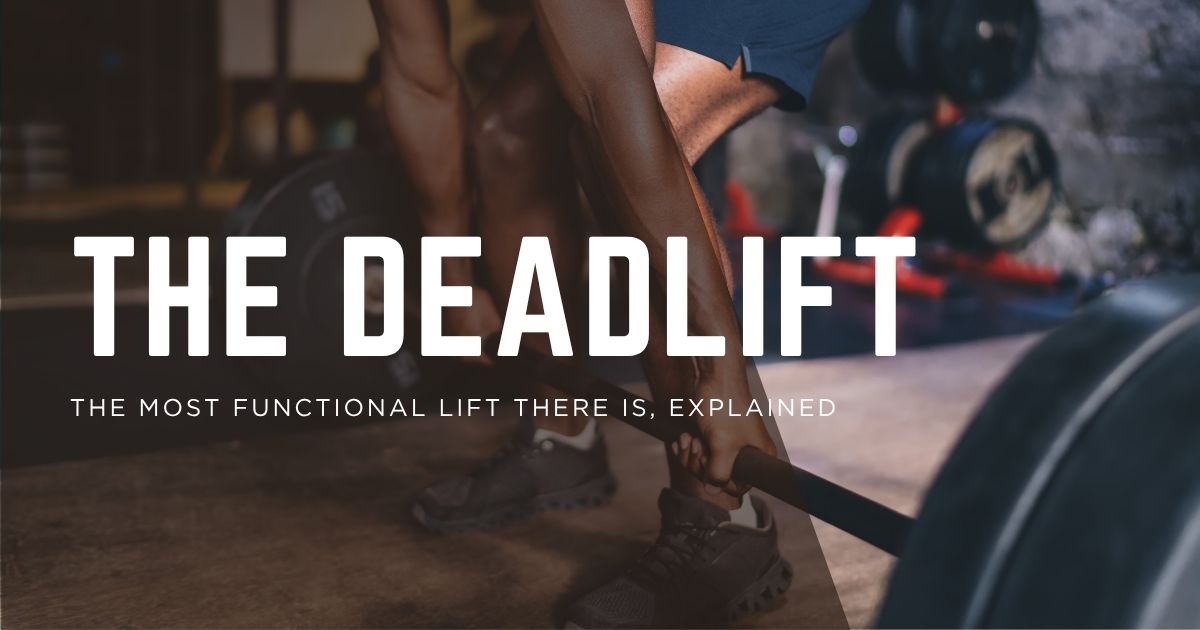
The deadlift gets categorized as a pure strength movement, something you do to build a bigger number. This framing misses what makes the deadlift one of the most functionally relevant exercises in training.
The deadlift is a hip hinge pattern under load. It trains you to pick things up from the ground safely and efficiently. It develops the posterior chain (glutes, hamstrings, and spinal erectors), which are the primary muscles responsible for maintaining posture, generating hip extension power, and protecting the lumbar spine during loaded bending.
Every time you pick up a child, lift a suitcase, move furniture, or bend down to grab something heavy, you’re performing a deadlift pattern. The question isn’t whether you do this pattern in daily life. You do. The question is whether you’re strong enough in this pattern to do it without risk.
What the Deadlift Trains
Posterior chain strength. The glutes and hamstrings are the largest and most powerful muscle groups in the body. The deadlift loads them through their full range of function, from a stretched position at the bottom to full hip extension at the top. Research by Martín-Fuentes and colleagues (2020) confirmed that the conventional deadlift produces among the highest glute and hamstring activation of any resistance exercise.
Spinal erector endurance and strength. Your erectors maintain spinal position under load. Deadlift training builds their capacity to resist flexion, the rounding that causes disc injuries during loaded bending. This is directly protective for real-world lifting tasks.
Grip strength. Grip strength is one of the strongest predictors of all-cause mortality and functional independence in aging populations. A 2018 meta-analysis by García-Hermoso and colleagues confirmed the dose-response relationship between grip strength and mortality risk. Heavy deadlifts develop grip strength as a direct training effect.
Core stability. The deadlift demands integrated core activation. All the muscles of the trunk must work together to maintain spinal position while the hips generate force. EMG analyses have repeatedly found that deadlifts produce comparable core activation to many dedicated core exercises.
Total-body coordination. The deadlift requires coordinated sequencing of hip extension, knee extension, spinal stabilization, and grip maintenance. This integrated demand develops the kind of whole-body motor control that isolated exercises cannot replicate.
The Deadlift in Conditioning
There’s a persistent gym culture objection to using deadlifts (and other compound lifts) in conditioning work: “Why would you turn a strength exercise into cardio?”
This objection reflects a misunderstanding of how exercises work. A deadlift at 60% of your max for sets of 10 in a circuit is a different stimulus than a deadlift at 90% for sets of 3 with full recovery. Same movement pattern, different physiological demand.
Using moderate-load deadlifts in conditioning develops work capacity specific to the hip hinge pattern. It trains you to maintain technique under cardiovascular stress, which is exactly what happens when you move heavy objects repeatedly in real life. Moving boxes for an hour, shoveling snow, and loading equipment are all sustained-effort hip hinge tasks.
The idea that exercises belong exclusively to one training domain is artificial. The deadlift can be a strength exercise, a hypertrophy exercise, or a conditioning exercise depending on load, rep range, rest periods, and programming context.
Deadlift Variations and Their Applications
Conventional deadlift. The standard. Feet hip-width, hands outside the knees. Highest posterior chain demand. Best for maximal strength development.
Sumo deadlift. Wide stance, hands inside the knees. Shifts demand slightly toward the quads and adductors. More upright torso position may be more comfortable for individuals with longer torsos or limited hip mobility.
Romanian deadlift. Starts from standing, lowering to mid-shin while maintaining nearly straight legs. Emphasizes the eccentric (lowering) phase and produces greater hamstring stretch under load. Superior for hamstring hypertrophy: the extended time under tension in the lengthened position is exactly the condition that research on long-muscle-length training keeps finding most productive for growth.
Trap bar deadlift. Using a hexagonal bar that allows a neutral grip with the load at your sides rather than in front. Reduces spinal shear force and allows a more upright pulling position. Research suggests comparable overall muscle activation with reduced lower back stress, making it an excellent choice for higher-rep work, conditioning circuits, and individuals with back sensitivity.
Single-leg Romanian deadlift. Unilateral hip hinge that develops balance, single-leg strength, and addresses asymmetries between sides. Particularly valuable for injury prevention and athletic transfer.
Programming the Deadlift
For strength: 3-5 sets of 3-6 reps at 75-90% of max, 2-4 minutes rest. Focus on load progression across weeks.
For hypertrophy: 3-4 sets of 8-12 reps at 60-75% of max. Romanian deadlifts and trap bar deadlifts work best in this range. Emphasize eccentric control.
For conditioning: Moderate load (50-60% of max), higher reps or time-based intervals, minimal rest. Technique must remain a hard constraint. When form degrades, the set ends.
The deadlift doesn’t need to appear every session. Two to three sessions per week with some variation of the hip hinge pattern (conventional deadlift, RDL, single-leg RDL, kettlebell swing) provides adequate stimulus for strength, hypertrophy, and pattern competency.
The FLEX Program includes hip hinge variations in every training block, programmed across the strength-hypertrophy-conditioning spectrum based on the training phase and weekly objectives.