Pistol Squat Alternatives: Single-Leg Strength Without the Complexity
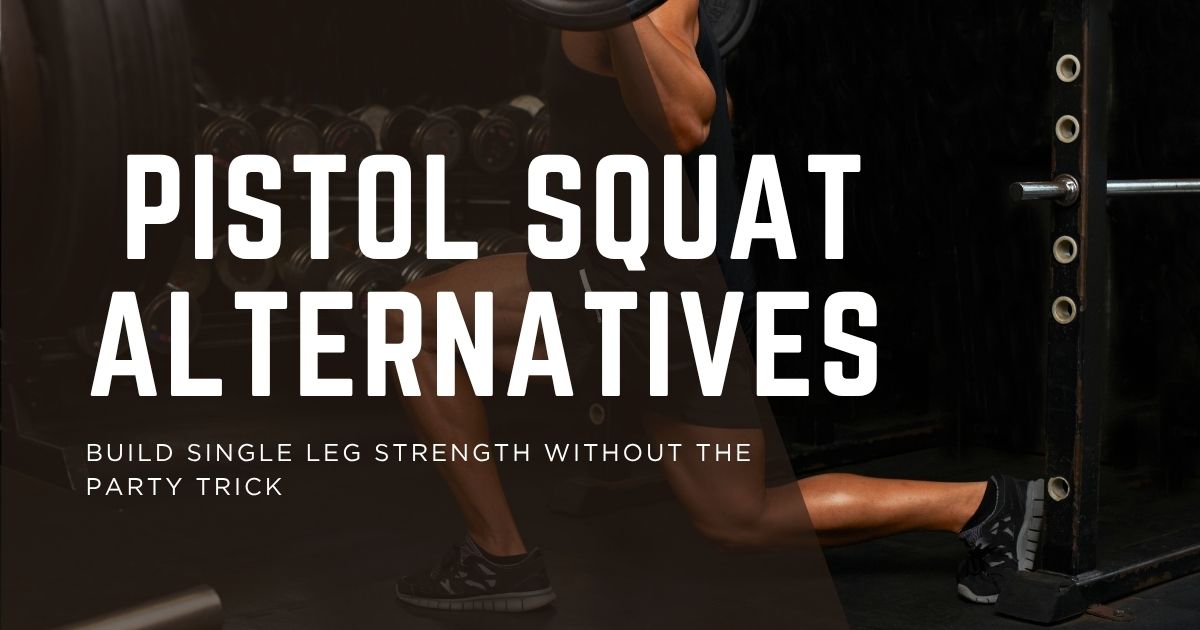
The pistol squat (a full-depth single-leg squat with the non-working leg extended in front) is an impressive movement. It’s also an impractical prerequisite for single-leg training. The pistol demands exceptional ankle mobility, hip flexibility, balance, and single-leg strength simultaneously. Many people who are strong enough to do pistol squats lack the mobility. Others have the mobility but not the strength.
Single-leg training matters regardless of whether you can pistol squat. These alternatives build the same unilateral strength, address side-to-side imbalances, and develop balance without requiring extreme mobility or movement complexity.
Why Single-Leg Training Matters
Real-world movement is predominantly unilateral. Walking, running, climbing stairs, and changing direction all require producing and controlling force on one leg. Bilateral exercises like back squats train overall lower body strength effectively but can mask significant asymmetries between legs.
Research by Helme and colleagues (2019) found that meaningful between-limb strength differences are common even in trained individuals. Whether asymmetry directly causes injury is still debated in the literature, but the practical point stands either way: bilateral lifts hide the difference, and single-leg training is the only way to find it and fix it.
Alternative 1: Bulgarian Split Squat
Rear foot elevated on a bench, front foot flat on the ground. Lower until your rear knee approaches the floor, then drive back up through the front foot.
This is the gold standard pistol squat alternative. It provides full single-leg training stimulus with significantly less balance and mobility demand. The rear foot provides stability without meaningfully contributing to force production.
Progression path: bodyweight, goblet hold, double dumbbell, barbell front rack, and barbell back rack. Loading potential is substantial, and many trained individuals work up to 80-100+ pounds per hand on dumbbells.
Programming: 3-4 sets of 8-12 per side for hypertrophy, 4-5 sets of 5-8 per side for strength.
Alternative 2: Step-Up
Step onto a box or bench, driving through the working leg to full hip and knee extension at the top. Control the descent on the same leg.
The step-up trains the concentric phase of single-leg squatting with minimal eccentric stress. Box height determines difficulty. Higher boxes increase range of motion and require more hip and knee flexion strength.
Key technique point: avoid pushing off with the trailing leg. All force should come from the working leg. Touch the trailing foot to the box lightly for balance only.
Programming: 3 sets of 10-12 per side with moderate load. Use as an accessory after primary squat work.
Alternative 3: Skater Squat
Stand on one leg, bend the non-working leg behind you, and lower your rear knee toward the ground while maintaining an upright torso. This is essentially a single-leg squat without the rear foot elevated.
The skater squat is closer to the pistol squat in terms of balance demand but without the extreme ankle and hip mobility requirements. It trains single-leg strength through a deep range of motion with a more natural body position.
Progression: use a pad or target behind you to control depth. Start with a higher target (less depth) and progress lower. Add load via a goblet hold or weight vest once bodyweight becomes manageable.
Programming: 3 sets of 6-10 per side. Quality over volume. These are demanding on balance and control.
Alternative 4: Single-Leg Leg Press
The leg press allows heavy single-leg loading with zero balance demand. This makes it ideal for pure strength development when balance or coordination limitations prevent adequate loading on free-weight single-leg exercises.
Place one foot in the center of the platform. Press through the full range of motion. Control the eccentric.
Programming: 3-4 sets of 8-15 per side. The leg press accommodates higher rep ranges well because systemic fatigue is low relative to the muscular demand.
Alternative 5: Rear-Foot-Elevated Split Squat with Deficit
Bulgarian split squat with the front foot on a small platform (2-4 inches). This increases range of motion at the bottom, providing a greater stretch on the hip flexors and quad of the working leg.
This is an advanced variation that approaches pistol squat depth without the balance complexity. It’s the closest substitute for the full pistol squat training stimulus.
Programming: 3 sets of 6-10 per side. Use moderate loading because the extended range of motion increases demand significantly.
Alternative 6: Assisted Pistol Squat
Hold onto a doorframe, TRX strap, or squat rack upright and perform a full pistol squat with assistance. Use only as much support as needed to maintain control. Over time, reduce the assistance until you can perform the movement unassisted.
This is the correct progression path if the pistol squat itself is your goal. It allows you to practice the exact movement pattern while building the strength and mobility required to perform it independently.
Alternative 7: Box Pistol Squat
Perform a pistol squat to a box or bench. The box provides a depth target and a brief moment of support at the bottom. Start with a higher box and reduce height as strength and control improve.
This removes the need for mobility at the deepest portion of the range while still training the single-leg pattern.
Choosing the Right Alternative
If your goal is pure single-leg strength: Bulgarian split squats and single-leg leg press allow the most loading and progressive overload.
If your goal is progressing toward pistol squats: assisted pistol squats and box pistol squats practice the specific movement pattern while building capacity.
If your goal is athletic transfer and balance: skater squats and step-ups train proprioception (position sense) and coordination alongside strength.
For most people, Bulgarian split squats should be the primary single-leg exercise. They’re loadable, scalable, and train the full range of single-leg strength without unnecessary complexity.
The FLEX Program includes single-leg work in every training block, with exercise selection matched to individual ability. The progression path builds from supported variations to loaded split squats over time.